Posts

Showing posts with the label Reading

Reading Notes: The Giant Crab, and Other Tales from Old India; Part B
Image
All readings derived from  The Giant Crab, and Other Tales from Old India by W. H. D. Rouse Union is Strength Very clever lesson that was incorporated in the story. Here, the trapper knows that, even though his tactics were not working on the clever quails, eventually they would begin to quarrel with each other and get trapped This is a common tale regarding the faults of human nature, even when they are in a good position, eventually conflicts do arise and it can lead to the down fall of the whole group! The dialogue was very fanciful and exaggerated speech For example "A lie, is it? Hoity, toity, how high and mighty we are, to be sure! I suppose it is you life up the net, all by yourself, when the man throws it over us!" This is something that is uncommon in today's conversation but is very prominent in stories such as this. This story does not start nor end with any stereotypical introductions or conclusions (if you consider "there once ... " a...

Reading Notes: The Giant Crab, and Other Tales from Old India; Part A

Image
All readings derived from The Giant Crab and Other Tales of Old India , by W. H. D. Rouse The Crocodile and the Monkey Story is told from 2nd person point of view, with references to the narrator talking to the readers directly with uses of "you." Vivid description of the crocodile, including the size of the animal, the hardness and color of its scales, the length of the jaw, the sharpness of its teeth, and how to refer them to things in real life such as a bed. Animals' names are usually just the name of the animal itself. In this example, the case of the wife and husband crocodiles were with prefixes such as "Mr." and "Mrs." This story was another author's recreation of the "Monkey's Heart" as I've read in previous Jataka tales. However, in this one, there was more emphasis on the point of view and background of the crocodiles and the dialogue between them The Wise Parrot and the Foolish Parrot Starts off with ...

Reading Notes: Twenty Jataka Tales; Part B

Image
All stories retrieved from Twenty Jataka Tales  by N. Inayat The Two Pigs Usage of onomatopoeia as the introductory sentence to create curiosity within the readers. This can be a great way to get the readers' attention by using simple sound-like descriptions, such as "tick-a-tack" in this story Also included traditional fairy tale-like ending "... lived happily ever after" to create sense of comfortability and sense of happy ending in a story meant to be read to children Again, inclusion of something mystical that influenced the behavior and thought processes of humans and their faults, which in this case is the power of love to conquer all Also included the instance of royalty, such as a king What is the effect of inclusion of a king and why is it effective? What feelings does this inclusion create? How does it essential to the plot of the story? Ways to rewrite this From the perspective of the drunken men From the perspective of the king Told...

Reading Notes: Twenty Jataka Tales; Part A

Image
All readings were retrieved from Twenty Jataka Tales , by N. Inayat The Monkey Bridge I've noticed that most of these Jatakas originating from India bear many significant geographical locations. Such as for this story, it doesn't mention some river, but does mention the Ganges, which is a culturally important river in India. Another indication is the Himalayas. Diction is simple and easy to understand, no usage of complex words Senses, such as taste and smell are heavily emphasized and inclusion of exclamation points to start the emphasis of feeling Again, inclusion of some form of leader and/or royalty, which in this case, King of the monkeys. The actions and sacrifices of the monkey King was significant in its effect on how he treated his kingdom after he had found the Monkey King, which in way teaches a lesson for both the readers and the character in the story. The Guilty Dogs Just like the story above, there included the aspect of royalty such as the king of...

Reading Notes: More Jataka Tales; Part B

Image
All readings were retrieved from More Jataka Tales , by E. C. Babbitt The Foolhardy Wolf Here, the dialogue of the characters in the story developed in a format that is each line is its own separate dialogue, makes it easier for the readers to read and follow along the conversation of the story The theme of the story talks about the reckless and arrogant nature of the wolf, which is another reference of human fallacy Story depicts the wolf first as humble and well-doing, and from there is where the story changes accordingly to the growing arrogance and greedy nature of the wolf, which saw its end. Images in the story is also separated within the context of the story, which allows for the readers to gauge in captivation of the reader's attention (Elephant Kills the Wolf. Source: Gateway Classics )

Reading Notes: More Jataka Tales; Part A

Image
All notes below are derived from More Jataka Tales , by E. C. Babbitt The Girl Monkey and the String of Pearls Presentation of the story itself is in format of shot paragraphs, usually around 2-3 sentences, creates a sense of the developing of the story The dialogue, whether it was between the guards or the monkeys, was never divided into separate lines, but in concise paragraphs Pictures was inserted between the stories, rather than just the end. Theme in the story showcases the human weakness of arrogance, as in the monkeys showing off the pearls that she had to the other monkeys as a brag, which led to the confiscation of the pearls back The Tricky Wolf and the Rats Alike most of the traditional stories of the faults of humans, this one was showcased in the wolf, where his trickery ended in him being exposed by the Chief Rat Images were also included This time, both images were included between the lines of the story, neither being at the end of the story as usual. ...

Reading Notes: Jataka Tales, Part B

Image
The Elephant Girly-face, by E. C. Babbitt Sets apart a preface for the story that showed how the story could possibly change as it progresses. Here, the elephant, Girl-face, was depicted as kind and harmless, which sets the effect that foreshadows how the development of such as statement would change The elephant here depicts human traits, much of that of a small child where will act accordingly to whatever is being taught to them. Shows that humans can be a product of their environment and upbringing, shadowing what they observe. Traditional beginning start with "once upon a time, ..." The Banyan Deer, by E. C. Babbitt Here, there is no deceit found in terms of the relationship between the animals and the humans, however, there is a system of dialogue between the deers themselves that would drive the story The general theme of the story shows the main difference between a good and bad leader, with subtle differences in between The bad leader would tell the m...

Reading Notes: Jakata Tales, Part A

Image
How the Turtle Saved His Own Life, by E. C. Babbitt A classical story about how a non-human character, namingly a turtle, outwitted his/her human counterpart in benefit of itself Includes instance of royalty, mainly to underscore that even one of the most powerful and important humans can fall for such trickery and ignorance Usage of easy to understand, modern language  Underlines faults of human thinking, such as ignorance and being gullible The Turtle Who Couldn't Stop Talking, by E. C. Babbitt Again, usage of non-human characters but this time, story is not directly influenced in the story, but instead as accompanying and emphasizing components to the the story between the geese and the turtle Contrary to the first story, the Turtle here is depicted as the ones with fault Fault: talking too much, even in inappropriate situation that is emphasized as life-threatening Usage of the village children almost like the narrators to depict the theme of the story, "...

Reading Notes: Five Tall Sons of Pandu, Part A

The Indian Story Book: The Five Tall Sons of Pandu by Richard Wilson The Young Princes On of the reasons why I chose this version of the Mahabharata to read was due to it having a more focused scope of the Pandavas, which played an important role in the arc of the Mahabharata itself Tells the tale of how the talents of Arjuna matches the talent of Karna, who was from more humble beginnings than that of Arjuna, who was royalty Fascinating in terms of the matter that lineage and royal blood doesn't have anything to do with power or talent. Multiple backgrounds. Draupadi's Swayamvara This is where there is a major change to the story, where in the original story, Yudhishthira became the wife of all the Pandavas. However, in this version, Kunti tells Arjuna that Yudhishthira was to become the wife of the eldest Pandavas even though Arjuna won the challenge. Ongoing battle of skill between Karna and Arjuna, involves the use of disguises for Arjuna who was of royal b...

Reading Notes: PDE Mahabharata, Part D

Image
Bhisma Falls; Indian Myth and Legend by D. A. Mackenzie In the descriptions of the war, there were passages where there was no inclusion of dialogue, but just about how there was general happenings inside the war. As a reader, we know how war is not all entirely standstill, but it's moments like these that allows a rest before the storm. There was also inclusion of the aspect of "fate" derived from the death of Bhisma, which cna be told from a wise man or someone that can foresee the future. This adds on to the mystery of the story and allows the reader to continue reading to see if there ever was an end to the prophecy. Abhimanyu and Jayadratha;  Indian Myth and Legend  by D. A. Mackenzie There are emotionally taxing moments in the war, especially about Arunja's son and how he was "slain," which traumatizes Arunja to the point where he had to weep on the battlefied Scenes like this projects the humanity aspect of a story that is mismatched with...

Reading Notes: Mahabharata, Part C

Image
Life in the Forest by Indian Myth and Legend by D. A. Mackenzie I like the inclusion of sages, which is a form of wise men that offer wisdom and knowledge that is useful for the main character to use I like the dialogue that the brahmin talks to the heavens, which includes the god's name and title in traditional words of praise, this can be something that I would want to include in my general stories Arjuna and Shiva, Myths of the Hindus and Buddhists by Sister Nivedita  I liked the passage of the adventures of Arjuna in the Himalayas, without any inclusion of quotes. The passage all around, only includes only description about the mountains and forests around him along with his own general description  There was also mention of the "Great God" whose name was never included in the beginning; this insinuates a sense of curiosity that is instilled in the readers and makes the readers want to read more about the story and to find out who the "Great God"...

Reading Notes: PDE Mahabharata, Part B

Image
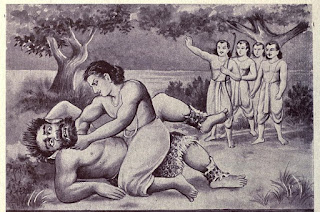
Bhima and Hidimba. Indian Myth and Legend by D. A. Mackenzie In the introductions of the story, the environment that was created by the author to set up the scene was filled with vivid terminologies There were also inclusions of animals and even supernatural beings, such as the asuras that were considered "demigods" and that they preyed on humans I think that adding the numerous different backstories of supernatural humanoids and demons would add more danger to the story and thus excitement. The demons and other humanoid beings of the stories should also each have their own individual names, alongside with their own set of unique powers as well. Characters such as Bhima showed confidence in his own strengths that can add dimensions to an otherwise non-described character. (Bhima Wrestling Hidimba. Source: Wikimedia ) Bhima and Baka. The Indian Heroes by C. A. Kincaid In the carefully described battle scenes, the author used a number of prepositional ph...

Reading Notes: Mahabharata, Part A

Image
Vyasa and Ganesha. The Mahabharata , A Summary by J. M. Macfie. This is prime example of a creation story, which I liked in terms of the inclusion of divine beings as well as absurdity in the content of the creation of the child itself.  Most stories, along with the inclusion of gods and goddesses, also have inclusion of high-ranking social figures, such as kings and sages, which is something that I think I should include in my stories as well. Also, there is always some sort of myths and legends itself that the readers have yet to know about in depth yet. For example, there is the mention of the "Five Pandu Brothers," which I feel induces curiosity within the readers themselves. King Shantanu and Ganga. Indian Myth and Legend by D. A. Mackenzie For the most parts, the main characters of the story always have the creation story that is related to, or created from, a king and/or a god/goddess which makes them stand out from any of the other characters in the storie...

Reading Notes: The Divine Archer, Part A

Image
The Divine Archer by F. J. Gould Birth of Dasharatha's Sons The inclusion of the objects on Rama's feet, that included the vajra, dhavaja, and ankusha, which translates to the thunderbolt, the flag, and the elephant goad. These were significant as each one of them was representative of culture. Vajra being a weapon of ritualistic purposes that symbolizes both the thunderbolt and the diamond.  Shows the skills of Rama, such as the mastery of the ancient religious texts, known as the Vedas, when he was only of a young age. Rama and Sita Shows the love between Sita and Rama, the author expressively portrays this through activities that each participated in, in order to show their love. For example, Sita prayed for Rama to the Bhavani, which translates to the "giver of life." and Rama often dreams about Sita. There was also included a contest to win Sita's hand in marriage by bending the Bow of Shiva, which Rama impressed the crowd with. The inclusion of ...

Reading Notes: PDE Ramayana, Part D

Image
The Bridge , Indian Myth and Legend by D. A. Mackenzie In terms of characterization, the story included appropriate and extravagant names for the powerful characters in the story.  For example, God of Ocean was the name of the being that was in control of the body of water that Rama was trying to get across to Lanka. In addition, all of the characters, especially godly and/or ones that the readers are yet to know, are followed by with their lineage title. For example, the author of the story included Nala, "son of Vishwakarma, the divine artisan ... " This is something that I could add to the extravagance in the description of the characters I will use in my story. Notice excessive usage of commas and long and visually descriptive sentences. Rama Attacks , Myths of the Hindus and Buddhists by Sister Nivedita With the frequency of powerful enemies that Rama comes across during his journey, each one has their own characterization and division of power. In "Rama ...

Reading Notes: PDE Ramayana: Part B

Image
Dasharatha's Funeral.  Ramayana, the Epic of Rama, Prince of India  by Romesh Dutt These passages showing Bharta's grief for his passed father was by far one of the more detailed and emotional ones of the story. Maybe it's to exemplify the importance of the event and how it might be a turning point for the story. It also enables pathos within the readers.  When in grief, characters tend to cry out to the heavens, using the word "O" quite often Viradha. The Ramayana by Manmatha Dutt This is another action scene, but something I've noticed is that as the journey goes one, the demon antagonists get stronger and stronger. This demon had the ability to protect itself from sharp weapons Rama is quick witted and has to think of the situation as to how to defeat the demon, and ultimately does. This is something that I would want to incorporate within my characters. Viradha the demon, when it dies, also cries out to the heavens but does not seem to curse R...

Reading Notes: PDE Ramayan, Part A

Image
King Dasharatha. Indian Myth and Legend by D. A. Mackenzie When talking about the setting of the story, the author included beautiful, detailed descriptions of the buildings that were there, what the streets were composed of, etc. There were also descriptions of animals in there that were written poetically when talking about the rustling of the winds.  Quick mention of the great gods, Vishnu, Indra, and Shiva, which puts in perspective the role of divinity within Indian Epics themselves. Rama's holy divination leading to his own creation and telling of fascinating adventures throughout is basis to the plot line. Rama: Avatar of Vishnu.  Indian Myth and Legend  by D. A. Mackenzie Inclusion of conflict that is currently going on up the godly world, which coincides with the main storyline. I think that the creation of multiple plot lines make the stories even more interesting to read especially with how big divinity plays a role in the stories! Thataka.  ...

Week 2 Reading Anthology

Image
Foolish, Timid Rabbit  Author:  Ellen C. Babbitt author uses "once upon a time" as introduction integrates lesson that one must not follow the rest of the group, or the fallacy of false rumors short, concise sentence that adds strategic breaks to the reading of the stories Turtle  Author: Ellen C. Babbitt general theme of foolishness and the fallacies/consequences of their bad habits the turtle's greatest weakness was that he talked too much and ended up dying also talks about ignorance of others and the genius of animals. stories are generally written in 3rd person POV Crane and Crab  Author: W. H. D. Rouse general theme of the cunning and the witted, where teaches a lesson that tells the people who try to deceive others often pay for it themselves Monkey and Croc  Author: Marie L. Shedlock again tells general theme of deceit and being outwitted by another character Starts story with background of the animal, or main protagonist Ends the s...

Week 2 Reading Overview

Image
I think I will be choosing the PDE Ramayana Online over P. K. Narayan's Ramayana for several reasons. One of which being is that the PDE version compile numerous of different authors and styles that I feel can allow for better understanding of the epic overall from multiple point of views. Second reason is that there are audio versions and also numerous illustrations. One of my favorite thing about myths and legends are the fantasy components that associate with them. Therefore, being a visual learner, I feel like I would much enjoy the epic even more. The last reason is, well, it's free on an online platform and honestly, who doesn't love free? One of the comics that interested me was " Ancestors of Rama ", due to the matter that it dealt with a divine intervention and also intersection between the Raghu and Indra, one of the more better known deities of Indian mythology. Another comic that intrigued me was " Vishvamitra ", due to my fascination with ...